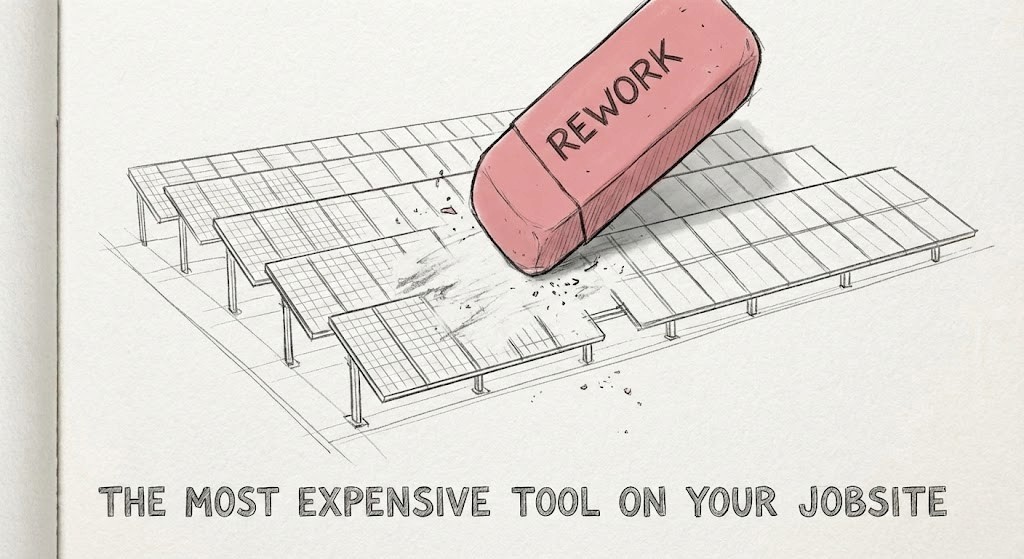
There is a math equation in construction that every Project Manager knows, but no one likes to talk about:
Building it Twice = Costing it Three Times. (Cost to Build + Cost to Demo + Cost to Rebuild).
We talked last week about the disconnect between Schedule and Procurement. But this week, we need to address an even more painful data gap: The disconnect between the Office (Engineering) and the Field.
The "Revision 4" Problem Here is the classic scenario: Engineering updates the site drawings to "Revision 4" to account for a terrain issue in Block 3. They save the CAD file to the server. They might even send an email.
But out on the site, the piling crew is in a dead zone. They are working off the "Revision 3" PDF they downloaded to their tablets two days ago.
They drive 500 piles. They hit their daily production targets. The Daily Progress Report (DPR) looks fantastic.
Three days later, the surveyor comes through and realizes every single pile is 6 inches too high relative to the new grading plan.
The Data Disconnect Why does this happen? Because Design Data and Field Data live in different universes.
Engineering lives in CAD/GIS.
Construction lives in Tracker Apps or paper forms.
Quality/NCRs live in a separate spreadsheet.
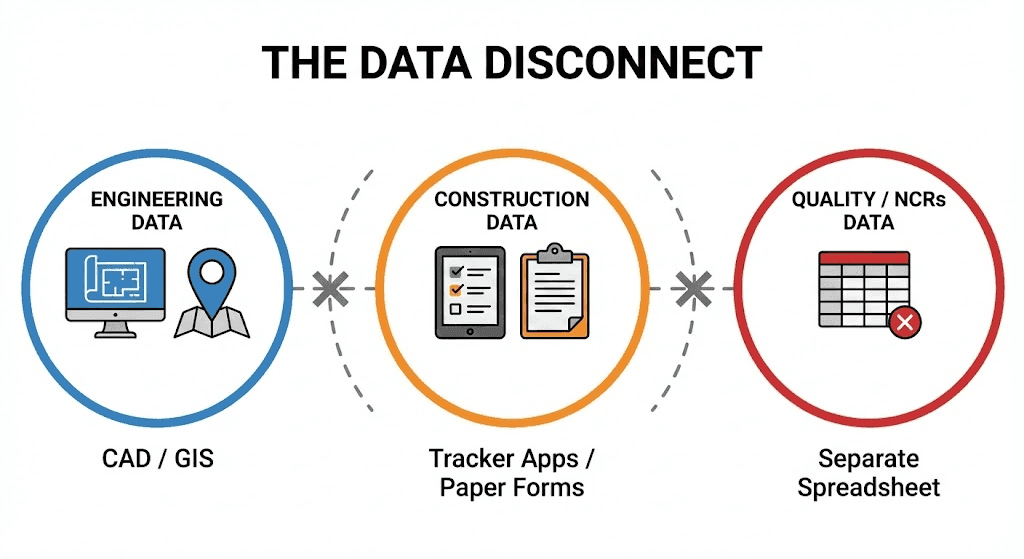
Because these systems are siloed, you don't catch the error until the physical work is done. You end up with NCRs for "Height above ground," "Distances between piles," or "Rotation of the pile"-errors that could have been prevented if the data was connected.
The Question You Should Be Asking We have accepted rework as "just part of the job." But in 2026, with the margins on solar projects getting tighter, we can't afford to pay for the same MWs twice.
What if you didn't have to wait for a surveyor to catch a mistake? What if your reporting dashboard didn't just show you "Percent Complete," but actually overlaid "As-Designed" vs. "As-Built" in real-time?
What if your BI tool was smart enough to stop the rework before the pile was driven?