It’s the scenario every Wind Project Manager dreads.
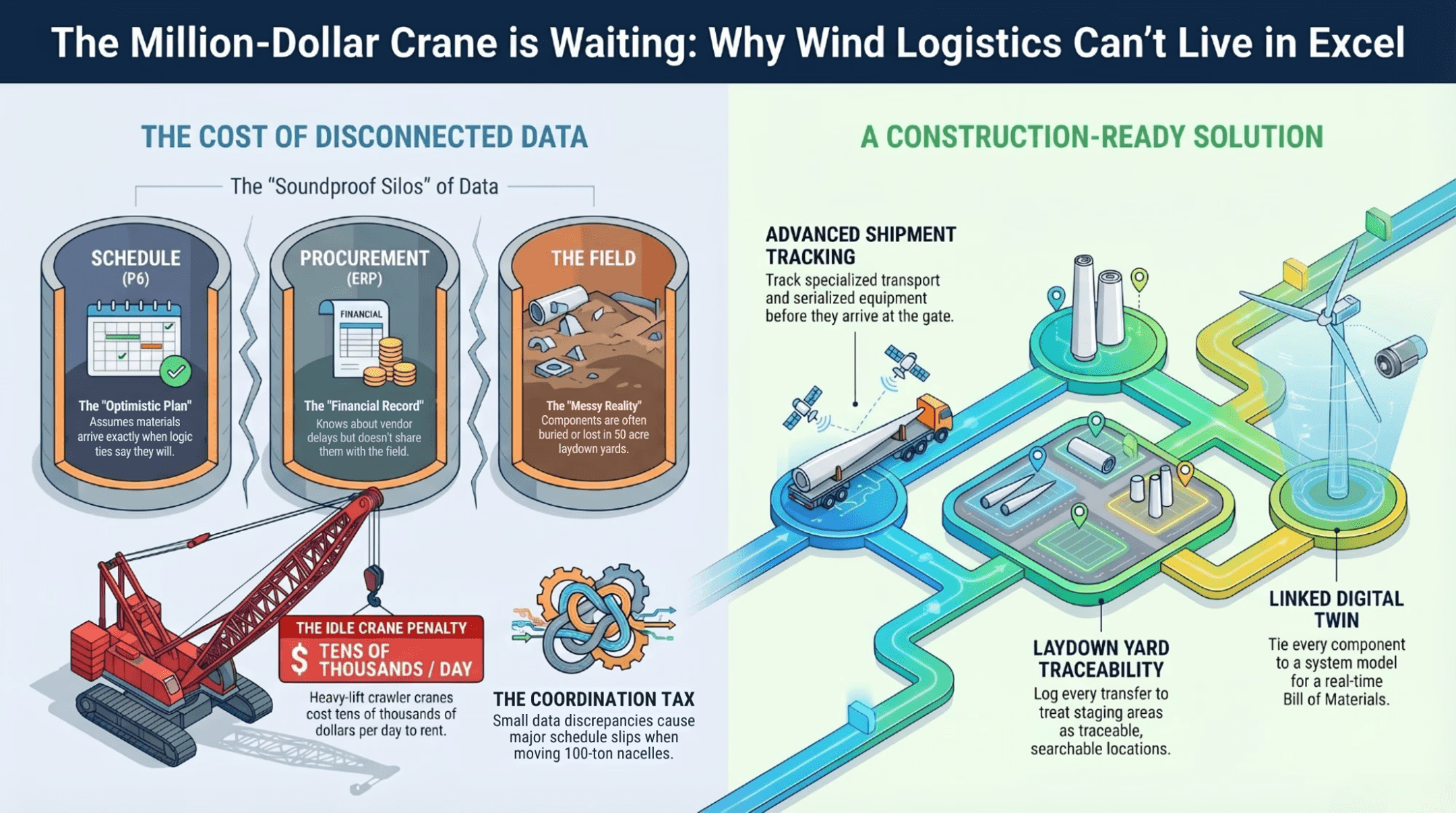
It’s Tuesday morning. Your P6 schedule says the erection of Tower Sections 1 through 3 for WTG-14 starts today. The heavy-lift crawler crane—which costs tens of thousands of dollars a day to rent—is mobilized and ready. The crew is on the clock. The Daily Progress Report (DPR) says you are green for the week.
But there’s a massive problem: The tower sections aren’t at the pad.
You call Procurement. They tell you the ERP shows the massive steel sections were ordered months ago. You call Logistics. They tell you the specialized transport is delayed, or worse, the sections are buried somewhere in a 50-acre laydown yard and the transport crew can't locate the exact serial numbers needed for this specific turbine.
Your schedule is green. Your budget is bleeding red. And your data lied to you.
The Most Expensive Disconnect in Construction
In solar, losing track of a pallet of modules is a headache. In wind construction, losing track of a serialized blade set or a nacelle brings the entire critical path to a grinding halt.
We often talk about "project visibility," but the reality on most wind sites is that critical data is trapped in soundproof silos:
The Schedule Silo (P6): The optimistic plan. P6 assumes materials arrive exactly when the logic tie says they will.
The Procurement Silo (ERP): The financial record. Your ERP lives in transactional reality—it knows about lead time changes and vendor delays, but it keeps that secret to itself.
The Field Silo: The messy reality of what is actually sitting in the staging area.
Because these systems don’t talk, your planner is manually updating the schedule based on week-old emails. By the time the schedule reflects the procurement delay, it’s too late to re-sequence the crane's path.
A Construction-Ready Approach to Wind Logistics
Unlike traditional systems built for generic corporate supply chains, TaskMapper Inventory focuses only on the steps that matter in the mud and dirt of the field.
Here is how we bring certainty to wind logistics:
Advanced Shipments: Track what is coming before it arrives—including exact quantities, specialized transport requirements, and serialized equipment. No surprises when the oversized load shows up at the gate.
Laydown Yard Traceability: Wind construction sites don’t have a single, neat “warehouse”. TaskMapper treats anywhere these massive components sit—laydown yards, staging areas, or the specific WTG pads—as traceable locations. Every transfer is logged, preventing components from getting “lost”.
Linked to the Digital Twin: Every nacelle, hub, blade, and tower section you receive or move is tied directly into the System Model—the digital twin of the wind farm. This creates an accurate, continuously updated Bill of Materials and a clear view of exactly what is on-site and where it is currently sitting.
Stop Paying the Coordination Tax
When you are coordinating the movement of 60-meter blades and 100-ton nacelles across hundreds of acres, even a small data discrepancy can create major schedule slips.
It’s not about replacing your corporate procurement system—it’s about ensuring what arrives onsite actually gets built the way it was planned, exactly when the crane is ready for it.
You can't build a connected energy grid with disconnected data. It’s time to knock down the walls between the trailer, the laydown yard, and the boardroom.