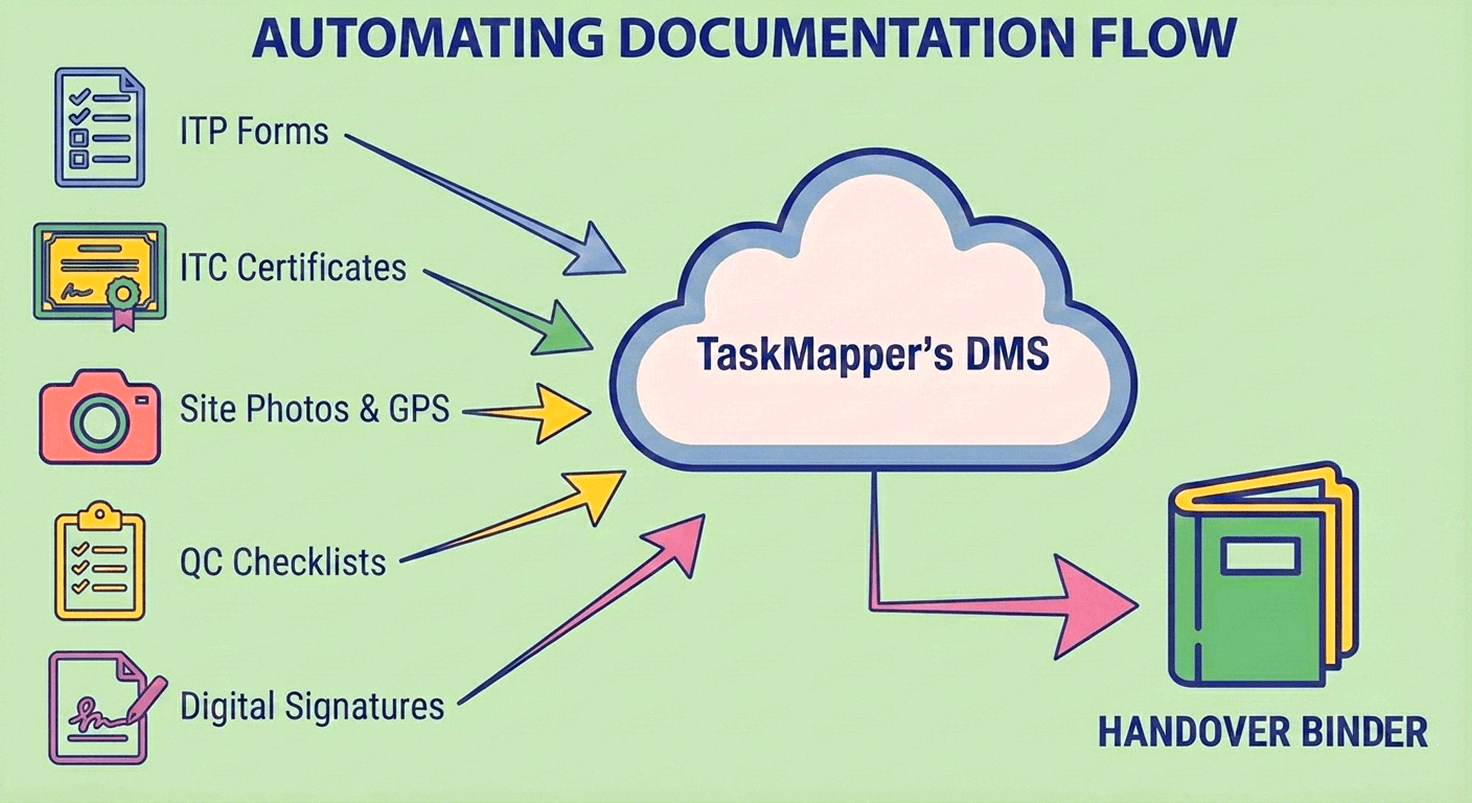
TaskMapper turns field QC forms into auto-generated, auto-filed, asset-linked records, so the handover binder is ready at COD (commercial operation date). This post is for EPCs, QA/QC managers, and owners and IPPs who need complete QC documentation without weeks of manual assembly.
What Is a Solar Handover Binder? What Documents It Contains?
A solar project handover binder, also called a closeout package, holds the full set of solar project closeout documentation: the QC, commissioning and as-built records the EPC hands to the owner at the end of construction. Owners, asset managers and O&M teams use it to confirm the solar site was built and tested to specification, and to trace any component back to its inspection, test results, approvals and supporting photos. Much of it lines up with IEC 62446-1, the standard for PV system documentation, commissioning tests and inspection.
Solar sites generate a mountain of QC and commissioning documentation:
ITPs (Inspection and Test Plans): define which inspections and tests happen at each stage, who carries them out, and the acceptance criteria
ITCs (Inspection Test Certificates): prove a specific inspection or test was carried out and passed
Torque checks: prove bolted connections on trackers, racking and modules meet the specified torque
Module QC: proves modules were checked for damage and installed correctly
Cable megger tests: prove cable insulation resistance meets the specification before energization
Civil inspections: prove grading, foundations, roads and drainage match the design
Commissioning records: prove systems were tested, energized safely and are performing as expected
As-built drawings: show what was actually built, including any changes from the IFC design
IV curve records: prove each string delivers the expected current and voltage at commissioning
Why manual handover documentation breaks down
Traditionally, these are captured through paper forms, scattered photos, and manual signature collection.
At COD, someone spends _weeks_ assembling a handover binder.
Manual construction documentation fails in the same places on almost every project:
Disconnected spreadsheets that each team maintains separately
Paper forms that get damaged, lost or retyped with errors
Missing signatures that hold up approvals
Misplaced photos that can’t be tied back to the inspection they support
Inconsistent templates from one contractor or block to the next
Duplicate records for the same inspection
Reports formatted by hand, one PDF at a time
Reports filed in the wrong folder, or not filed at all
No easy way to link a record to the specific asset it covers
These construction handover challenges leave QC documentation incomplete at the worst time, in the final weeks before COD.
TaskMapper turns this entire process into an automated workflow. Here is how TaskMapper’s construction quality control software handles it.
How automated ITP and ITC workflows change the process
Step 1: Capture QC Data with Digital Forms On-Site
Using TaskMapper Forms, crews capture:
Photos
GPS & time
Checklists
Observations
Digital signatures
Approval flows
Everything is structured, validated, and consistent. Forms are built from templates, so every inspector on every block works through the same fields in the same order. Mandatory fields stop incomplete submissions, geofencing checks the inspector is at the right location, and conditional logic asks for more detail when a check fails. Crews can fill in forms offline in the TaskMapper mobile app and sync once they are back in range, which matters on large solar sites with patchy coverage.

Step 2: Auto-Generate ITP and ITC PDFs from Your Templates
When a form is completed, TaskMapper automatically produces a polished PDF using your standard ITP/ITC Word templates.
These PDFs include:
Photos
Signatures
User stamps
Dates
Workflow details
The template is set up once per form, and every submission after that uses it. Photos, signatures and timestamps captured in the field go straight into the report. Construction quality documentation stays consistent from block to block, and QA/QC managers review a finished document instead of formatting one.
No manual formatting.
No stitching documents together.

Step 3: File Every Report in the Right DMS Folder
Each completed report is routed automatically into the correct document management system (DMS) location, such as:
QC
├── Mechanical
│ └── Torque Checks
└── Electrical
└── ITCs
Commissioning
└── Block 4
└── IV Curves
The folder path is set once in the form’s workflow, so the QC documentation for each report type lands in the same place. The DMS keeps each file version-controlled and searchable. For more on how it handles revisions, see Part 1: Fixing Document Chaos.
Zero manual filing.
Zero lost documents.

Step 4: Link Each Record to the Digital Twin
Because every form ties to an asset in the System Model, the final QC history becomes part of the digital twin:
Piles
Modules
Tracker rows
Inverters
Transformers
MV runs
At handover, the digital twin contains the complete as-built and QC record - without extra work.
This asset-level traceability keeps paying off long after handover. When an inverter trips or a tracker row underperforms, the O&M team can open that component on the map and see how it was installed, inspected and tested. Warranty claims start with the original QC and commissioning evidence already attached to the asset. Future inspections can be compared against the baseline recorded during construction. As forms are approved, the component’s status on the map can also update automatically, for example from “QC Inspected Started” to “QC Approved”.
What Asset Management Receives at COD
By COD, the handover binder already exists.
No scrambling.
No missing documents.
No manual assembly.
Asset Management inherits a living digital twin with full traceability - from the first pile installed to the final commissioning test. For owners and IPPs, that means:
A searchable history for each asset, from installation through commissioning
Faster warranty claims, with inspection and test records already linked to the component
Audit-ready QC documentation from the first day of operation
To find out more about how you can create an “assembly line” process for your QC documentation - book a demo to find out more.
Frequently Asked Questions
What is an inspection and test plan (ITP) in solar construction?
An ITP lists every inspection and test required for a scope of work, such as piling, tracker installation or cabling. For each step, it sets out the acceptance criteria, who carries out the check, and any hold or witness points where the owner or Owner’s Engineer needs to be present. The ITP is agreed before work starts and used to check the work as it progresses.
What documents are included in a solar handover binder?
A typical binder includes ITPs, ITCs, torque check records, module QC records, cable megger (insulation resistance) tests, civil inspection reports, commissioning records, IV curve tests, as-built drawings, approvals and supporting photos. IEC 62446-1 sets out the minimum documentation and commissioning tests for grid-connected PV systems.
What is the difference between an ITP and an ITC?
The ITP is the plan. It defines what will be inspected and tested, how, and against which criteria. The ITC is the record. It confirms that a specific inspection or test from the plan was carried out and met the criteria. One ITP usually produces many ITCs over the life of a project.
Which QC and commissioning tests are recorded before solar COD?
Common records include pile and torque checks, module installation QC, cable insulation resistance (megger) tests, continuity and polarity tests, string open-circuit voltage and short-circuit or operating current tests, IV curve tracing, inverter and transformer commissioning tests, and protection and grid compliance tests. The exact list depends on the project specification, the grid operator’s requirements and standards such as IEC 62446-1.