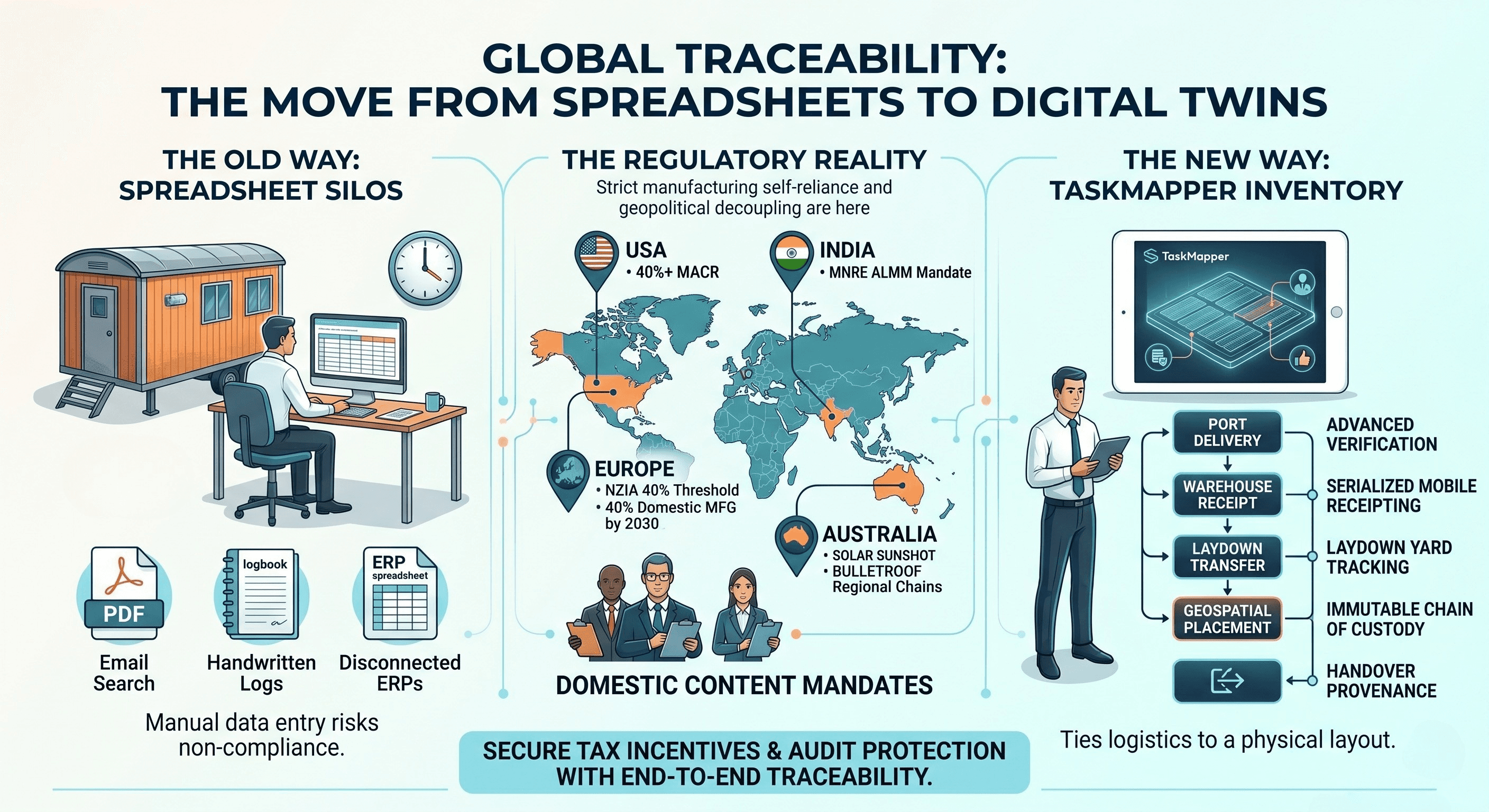
It is a quiet morning in the project trailer, and an independent compliance auditor pulls up a chair. They aren't looking at the structural integrity of your tracker rows; they are auditing your supply chain ledger. They pick a handful of random module serial numbers from a recently completed block and give you a simple directive: “Prove to me that these exact components comply with trade origin mandates, show me their component-level manufacturing lineage, and trace their custody from the port to this specific coordinate.”
The clock is officially running.
Your procurement manager opens an ERP spreadsheet to find the original purchase order. Your logistics lead digs through email folders for a port customs clearance PDF. Your field supervisor flips through a handwritten logbook trying to verify which laydown yard those pallets sat in before installation.
In clean energy construction, material tracking is no longer just a logistical task. It is a high-stakes legal and financial hurdle. If your asset traceability relies on disconnected spreadsheets and manual data entry, you aren't just risking a minor construction delay—you are walking directly into a multi-million dollar compliance trap.
The Global Clampdown on Siloed Data
Regulatory bodies worldwide have effectively synchronized their clocks. Governments are transitionary frameworks away from general deployment goals toward strict manufacturing self-reliance and geopolitical decoupling. If you cannot trace an asset back to its raw material source, you are exposed to devastating financial penalties or grid exclusion. Here is a summary of domestic content mandates in major solar markets:
1. United States: The July 4, 2026 FEOC Cliff
Under OBBBA, securing your base Section 48E or 45Y tax credits requires strict compliance with Prohibited Foreign Entity (PFE/FEOC) rules. For projects beginning construction in 2026, the Material Assistance Cost Ratio (MACR) mandates that at least 40% of direct material costs must be sourced from non-PFEs.
2. India: The June 1, 2026 DCR Mandate
The Ministry of New and Renewable Energy has drawn a firm line in the sand, granting no blanket extension for the Approved List of Models and Manufacturers (ALMM) List-II beyond June 1, 2026. From this date forward, solar installations must strictly utilize domestically manufactured Domestic Content Requirement (DCR) solar cells and modules, heavily penalizing or outright blocking non-compliant foreign imports.
3. Europe: Net-Zero Industry Act (NZIA) Resilience
The European Union's Net-Zero Industry Act enforces rigorous sustainability and supply chain resilience criteria in public auctions and procurements. It targets a 40% domestic manufacturing threshold by 2030, penalizing project designs that rely on geographically monopolized single-source ecosystems.
4. Australia: Solar Sunshot and the Future Made in Australia Plan
Australia is aggressively moving to reverse its systemic dependency where 99% of its clean tech components are imported. Backed by the federal $1 billion Solar Sunshot program, the government leverages massive production credits and capital grants to bridge the gap between local fabrication and cheap imports, demanding bulletproof regional supply chains from pit to panel.
Taskmapper offers Seamless Material Sourcing Traceability on the Digital Twin
Given this heavy focus being given by regulators on auditable supply chains - you cannot execute a multi-continental, compliant project using spreadsheets and emails as proof. That is exactly why TaskMapper Inventory is engineered to tie every logistical micro-step straight into the live physical layout of the site.
Instead of treating inventory as a back-office corporate afterthought, TaskMapper transforms every single component into a traceable node on your Digital Twin.
[Port Delivery / ASN] ➔ [Warehouse Receipt / Scan] ➔ [Laydown Transfer] ➔ [Field Issuance] ➔ [Geospatial Placement]
Here is how a construction-ready approach safeguards your compliance posture:
Advanced Shipment Verification: Log what is coming before it ever arrives—tracking exact serial counts and vendor origin certifications so that non-compliant components are flagged before they clear the front gate.
Serialized Mobile Receipting: When materials land in the staging area, receiving crews scan barcodes and serial markings instantly. The data links directly to the System Model, instantly verifying compliance metrics.
Laydown Yard Traceability: Clean energy installations don't use a single centralized warehouse. TaskMapper treats laydown yards, temporary staging zones, and block footprints as distinct geofenced locations, logging every internal transfer to eliminate the risk of components getting "lost" or mismatched.
Execution Linkage: Record exactly who took a component, when it was issued, and what specific field activity it was allocated to.
Handover-Ready Provenance: Every scanned physical serial number is permanently anchored to an absolute spatial coordinate on the interactive twin. When auditors demand verification, you don’t hunt down files—you simply click the asset on the map to display its complete, immutable chain of custody.
The True Bottom Line: > Compliance isn't admin work—it's risk mitigation. By matching your real-world supply chain to a living Digital Twin, you secure end-to-end audit protection, defend your tax equity incentives, and stop running your job site through a rearview mirror.