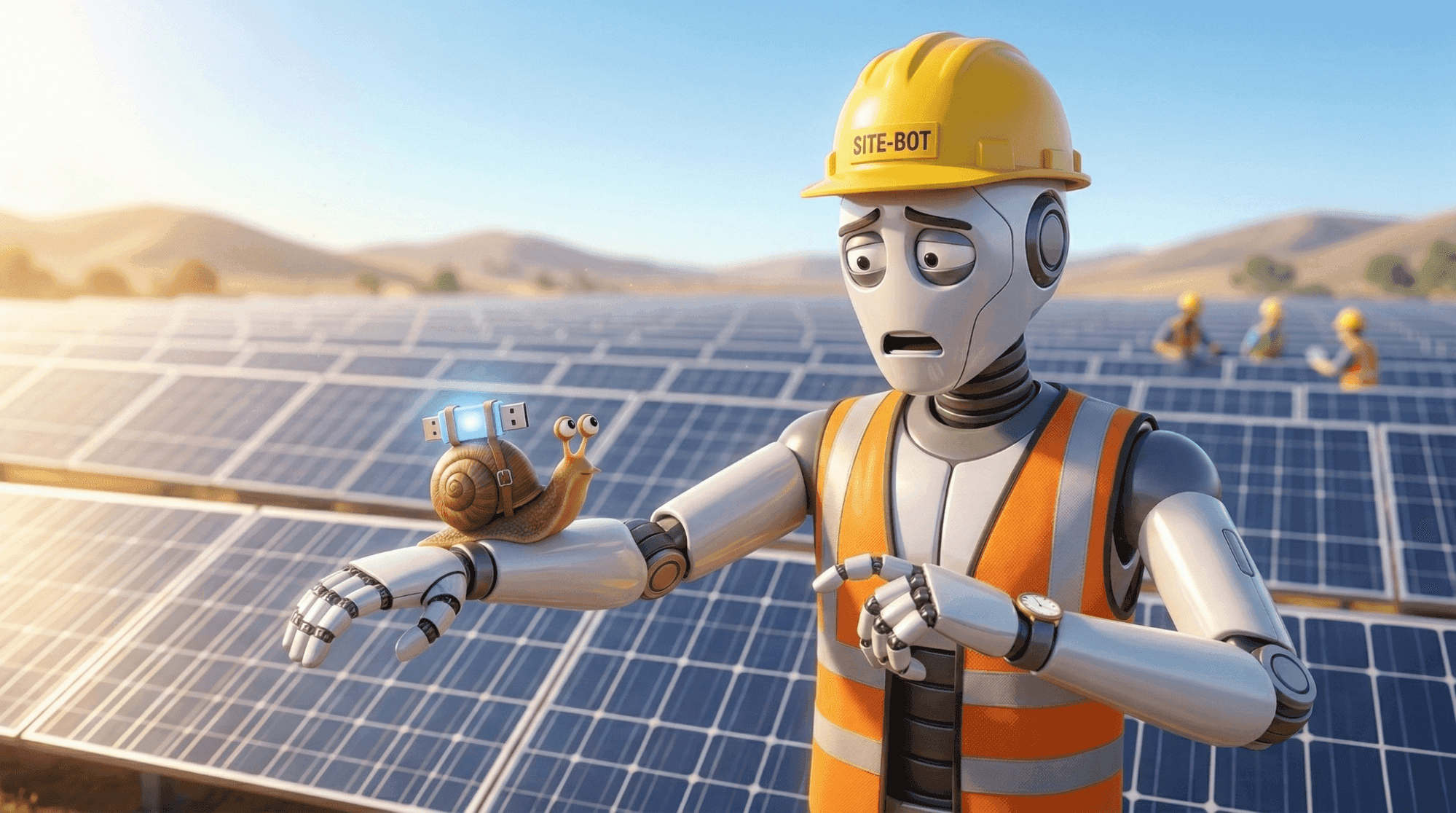
In Part 1, we eliminated unstructured spreadsheets. In Part 2, we gave our data a geospatial map using the Digital Twin. But even with perfectly structured, mapped data, there is one final hurdle standing between your solar site and predictive Artificial Intelligence: Time.
An AI model is only as smart as its latest data input. If your project relies on manual data entry that creates a multi-day gap between the field and the office, any AI prediction you generate will simply be looking in the rear-view mirror.
The Core Problem: The "Tuesday Disaster" and the Latency Tax
We live in a world of instant information, so we assume our project dashboards are "real-time". But in construction, the journey data takes from the field to the boardroom is often painfully slow.
Consider the "Tuesday Disaster" scenario: On Tuesday morning, a piling crew hits unexpected subsurface rock, and their refusal rate spikes to 25%. This is a critical issue. However, because field crews are working in a cellular "dead zone," that data is jotted down on paper or sits unsynced on an isolated app. It isn't until Friday that a Project Engineer manually exports, cleans, and aggregates that data into Excel.
By the time the dashboard updates on Monday morning, six days have passed. Six days of lost mitigation time. This 72-to-96-hour gap is called Data Latency. If you feed this delayed data into an AI algorithm, it cannot act as a predictive early-warning system; it can only tell you about a crisis you are already in.
The TaskMapper Solution: Erasing the Dead Zone
To make your site AI-ready, you have to kill the latency gap. You need continuous, automated data flows. TaskMapper achieves this through two distinct technological leaps:
1. Offline-First Mobile Operations: Utility-scale solar sites don’t come with perfect network coverage, and many blocks have no signal at all. The TaskMapper Mobile App is built as an offline-first tool. Field teams download their planned ITPs and maps in the morning, complete all their digital QC checks in the cellular dead zone, and the moment they return to the site office, the app automatically syncs everything to the central system.
2. Automated Drone Tracking: We are taking progress tracking a step further by using drones to automate updates. Drones can be scheduled to fly over the site daily, capturing high-resolution imagery that TaskMapper automatically processes to detect completed activities (like pile installation or module mounting).
The AI-Ready Angle: A Live Telemetry Feed
AI requires a real-time telemetry feed to thrive. By utilizing offline-syncing field apps and autonomous drone detection, TaskMapper ensures that your Digital Twin is updated continuously, rather than weekly.
When your AI agent finally arrives on site, it won't be starved of current information. It will have the minute-by-minute data required to instantly flag schedule risks and optimize logistics before they ever hit the budget.
Stay tuned for Part 4 next week, where we will tie this all together and discuss the transition from static reporting dashboards to intelligent "Decision Engines."