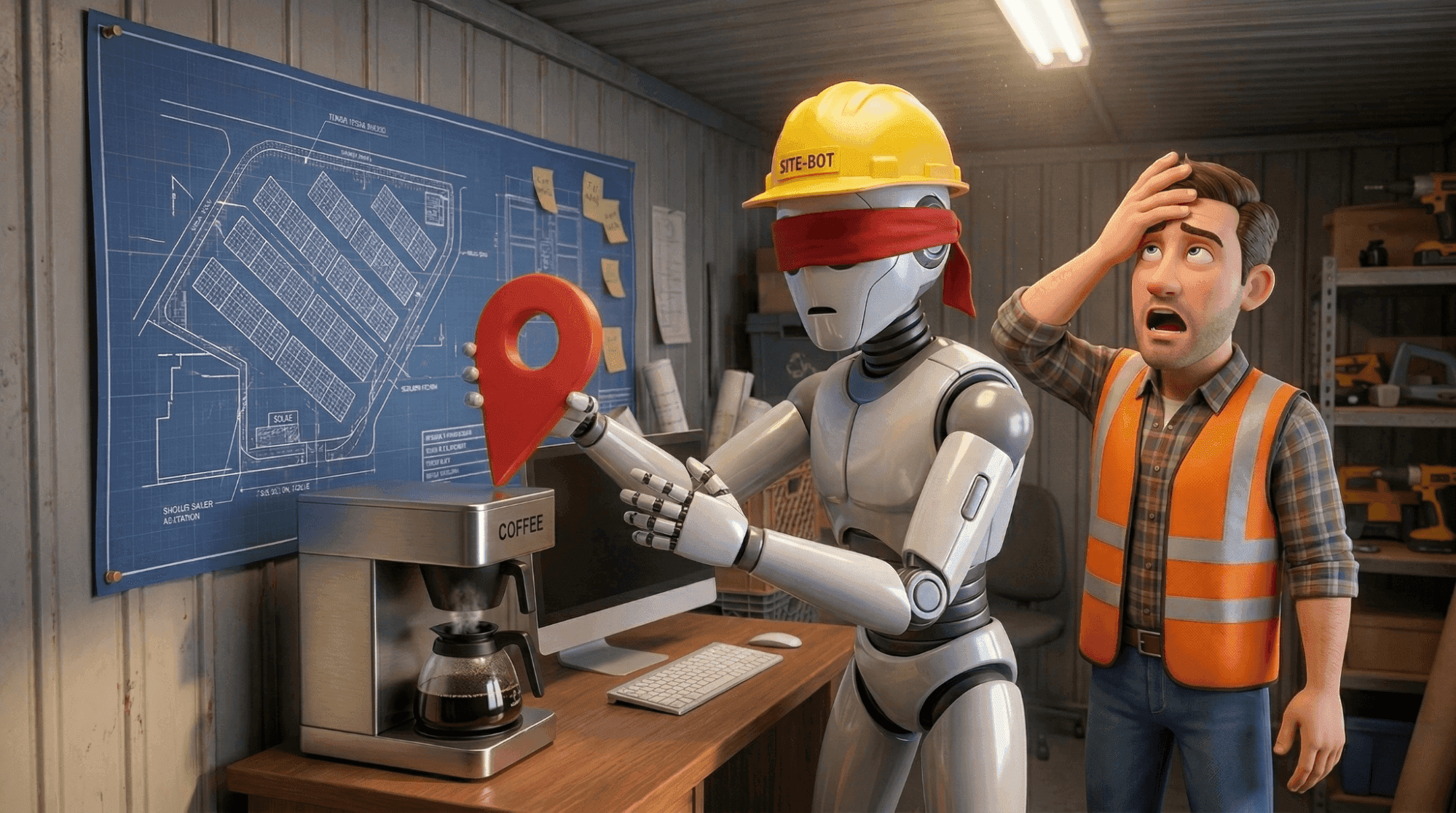
In Part 1 of this series, we discussed why eliminating unstructured spreadsheets is the first step to making your solar site AI-ready. But having clean, structured data is only half the battle.
If you hand a brilliant engineer a spreadsheet listing 10,000 delayed piles, their first question will always be: "Where are they?"
Artificial Intelligence is no different. AI cannot generate meaningful insights if it doesn't understand the physical reality of your 1,000-acre site. Knowing that a "tracker is delayed" doesn't help an algorithm optimize your project if it doesn't know what block that tracker belongs to, what civil work precedes it, or where it sits on the layout. Data without context is just noise.
The Core Problem: The Spatial Disconnect
On traditional solar projects, project data is highly fragmented across different departments: Engineering maintains the layouts in CAD, the planning team maintains the schedule in P6, and quality control logs issues in separate spreadsheets.
Because these systems are siloed, the data lacks a spatial relationship. If a piling crew hits unexpected rock in Block 4, that delay is recorded as a schedule variance, but the algorithm has no way of visually or spatially correlating that delay with the specific soil conditions, trenching paths, or adjacent civil work in that exact location.
The TaskMapper Solution: The Digital Twin
To make AI truly predictive, you have to give it a map. That is why TaskMapper is built entirely around a living Digital Twin.
The process begins by establishing a System Model that represents the plant's entire electrical and mechanical hierarchy, from modules to substations. TaskMapper's Maps module then overlays this digital structure onto the actual site layout, integrating CAD drawings, survey data, and construction zones.
Every asset-from a pile to a transformer-lives in this digital environment. When a crew completes an inspection or logs a non-conformance report (NCR), that data isn't just saved in a folder; it is linked directly to the specific geospatial coordinates of the affected component.
The AI-Ready Angle: Learning Spatial Relationships
AI thrives on relationships and patterns. By geographically linking everything on the site to a single source of truth, TaskMapper teaches future AI models how the site physically interacts.
When you overlay drone orthomosaics directly onto the digital twin, the system can already compare the "As-Designed" CAD files against the "As-Built" reality to automatically flag design deviations. As this spatially contextualized dataset grows, future AI agents will be able to learn complex spatial dynamics-for example, recognizing that "terrain grading issues in the northwest corner of Block 4 historically lead to mechanical delays in Block 5."
A list of completed tasks is just a scorecard. But a map of completed tasks tied to CAD layers and real-time drone scans is a predictive engine.
Stay tuned for Part 3 next week, where we will explore the "Latency Tax" and why you can't train an AI on data that is four days late.