The solar construction industry is buzzing with the promise of Artificial Intelligence. Everyone wants to implement AI agents that can predict schedule delays, optimize supply chains, and flag quality issues before they happen. But there is a massive roadblock standing between most solar sites and an AI-driven future: the data foundation.
Before you can implement AI, you have to look at how your project data is actually being captured. On most sites, critical information is trapped in unstructured, disconnected formats-paper checklists, loose PDFs, and isolated apps.
The Core Problem: The Friday Night Spreadsheet Rodeo
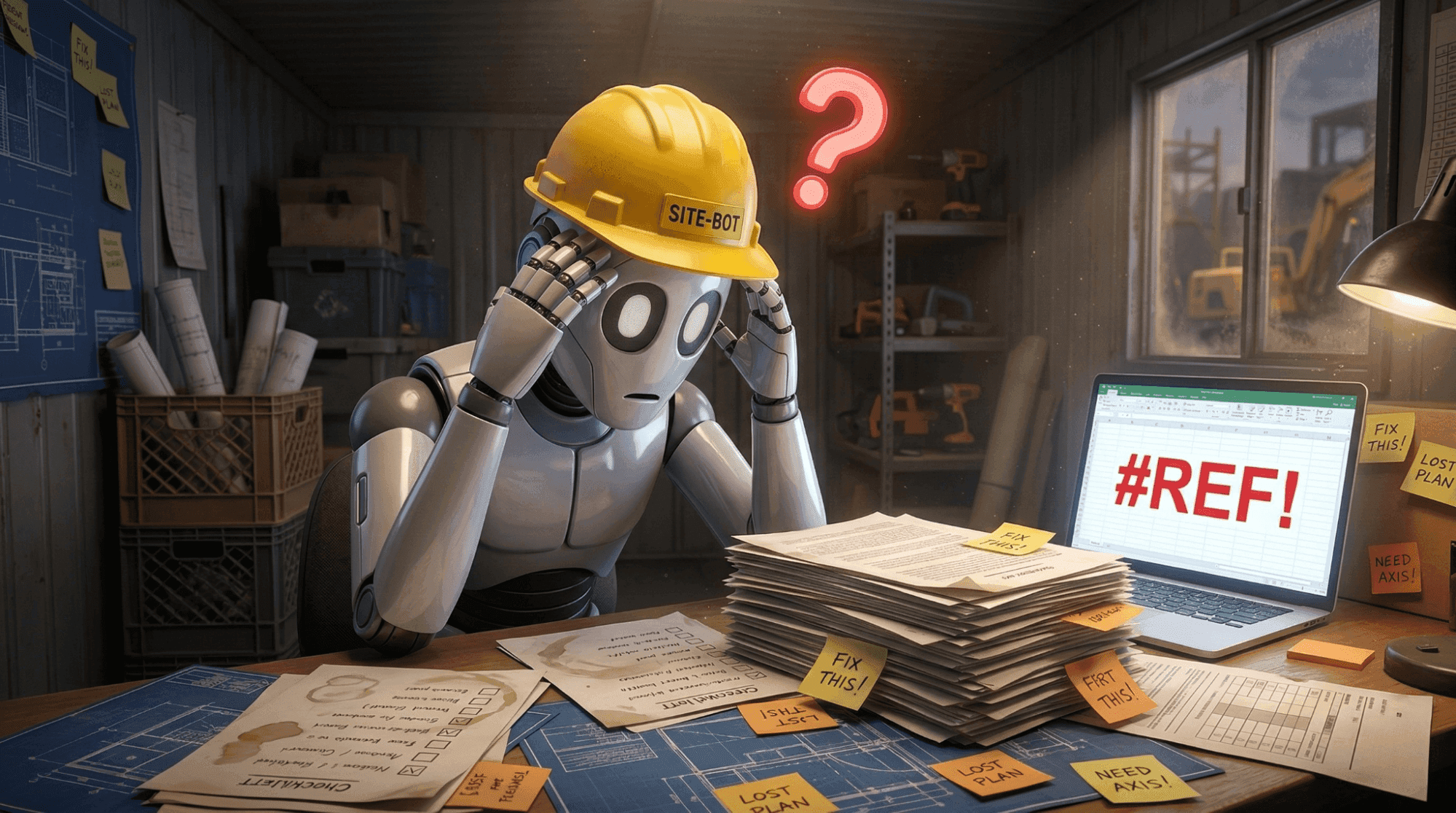
Consider the reality of how progress reporting happens today. It's often 6:00 PM on a Friday, and a highly-paid Project Engineer is hunched over a laptop, acting as a "Data Janitor". They are manually stitching together data from the schedule (P6), the procurement system (ERP), and field progress reports to build a Monday morning dashboard. They are trying to figure out why a VLOOKUP formula is returning a #REF! error.
If a brilliant engineer has to spend 10 to 15 hours a week manually cleaning and reconciling this data because it lives in distinct, soundproof silos, an AI agent isn't going to fare any better. AI cannot generate insights from handwritten daily progress reports, coffee-stained paper ITPs, or a disjointed Excel file.
The TaskMapper Solution: Forcing Structure at the Source
To make a site "AI-Ready," you must eliminate unstructured documents and manual data reconciliation. This is where TaskMapper changes the game.
Instead of paper forms and disconnected spreadsheets, field teams use TaskMapper’s digital workflows to capture progress and quality checks. When a piling crew or a mechanical team completes an Inspection Test Plan (ITP), they are guided through specific checks and approvals on their mobile app. They capture geotagged photos, time-stamps, and digital signatures that are immediately validated and stored in a structured format.
The AI-Ready Angle: Building the Data Foundation
By forcing data collection into structured, validated fields at the exact point of origin-the field-TaskMapper builds a clean, standardized dataset. Every update is linked directly to a spatial location on the map and tied to specific construction workflows.
This structured, digitized workflow is the ultimate prerequisite for AI.
You cannot train a predictive algorithm on messy, siloed data. But when your data flows continuously into a connected platform, you build the baseline requirement for future AI models to analyze trends, detect anomalies, and actually predict project outcomes rather than just reporting the past.
Stay tuned for Part 2 next week, where we will explore why AI needs a map, and how geospatial context ties all this structured data together.