It’s 6:00 AM on a Tuesday morning during the final stretch of project closeout. In the office, the engineering team has designed a flawless blueprint—a state-of-the-art hybrid solar-plus-storage layout. But out in the yard, you are entering the definitive phase where a complex energy asset must transition into active, operating revenue.
This is where your Commercial Operation Date (COD) is actively threatened.
Whether you are deploying an AC-coupled architecture or a tightly integrated DC-coupled system, the commissioning phase is where separate engineering worlds collide. A technician stands in the dust trying to reconcile a physical, serialized battery container with a flat Single Line Diagram (SLD) paper checklist. Nearby, an incomplete trench or a minor SCADA connectivity block quietly stalls an entire parallel testing sequence.
When thousands of multi-disciplinary variables must activate in a flawless chain, relying on spreadsheets, manual emails, and isolated files means making high-stakes choices using obsolete data.
The Hidden Gaps in Storage Closures
Battery Energy Storage Systems (BESS) are high-value, high-density, and high-risk assets where construction deviations introduce immediate downstream performance risks. Unlike basic solar arrays, a tiny structural defect in a battery yard can trigger severe operational issues later.
Consider what commissioning teams are regularly up against:
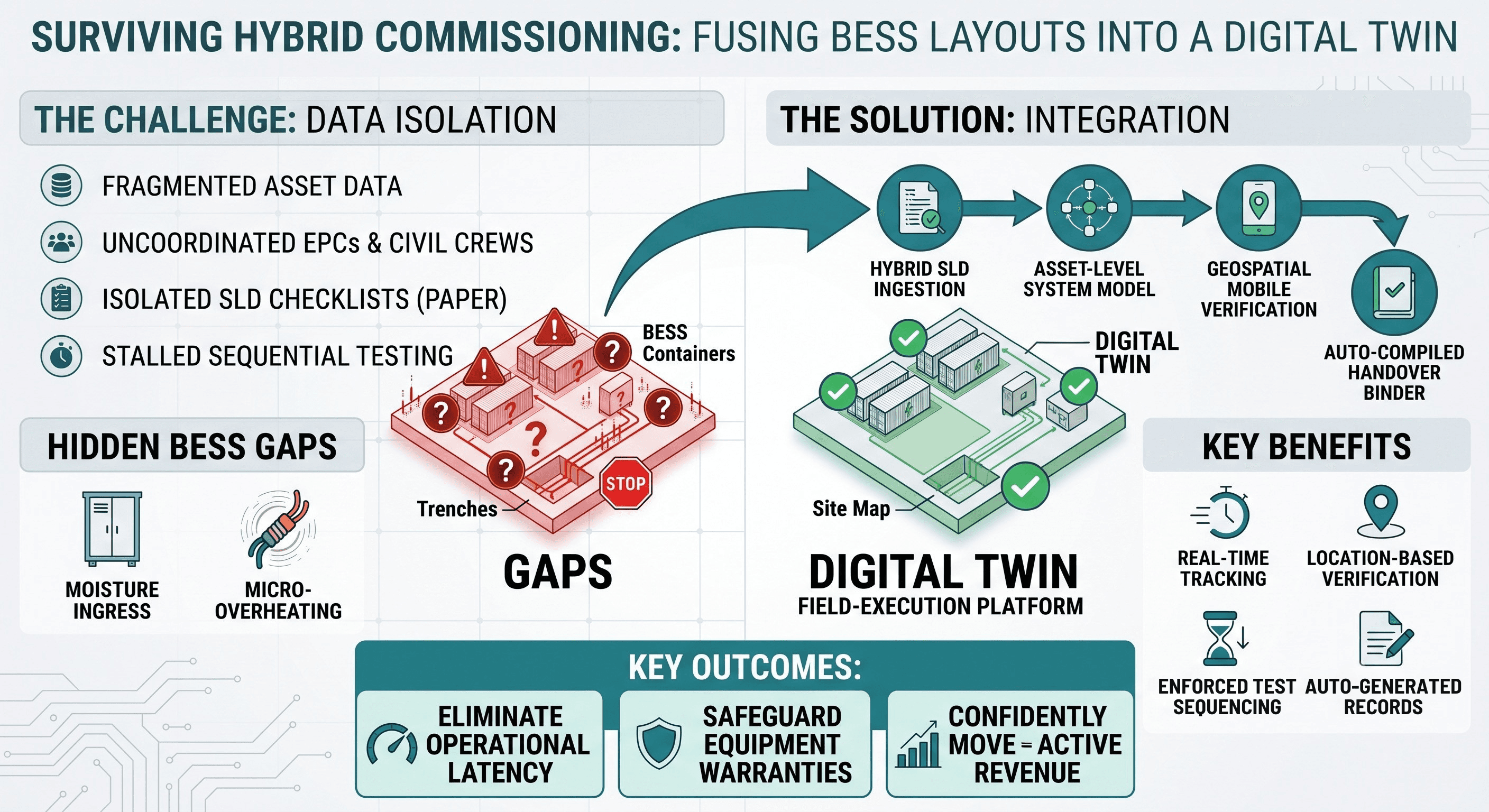
The Vulnerability Layer: Improperly sealed enclosures allow moisture ingress, while poor cable terminations drive micro-overheating events.
The Sequential Trap: BESS testing is an unyielding sequential process spanning mechanical completion, fire safety validation, SCADA integration, and performance testing. One block or documentation gap stalls the entire window.
The Detached Data Burden: Traditional inspections are completely disconnected from exact coordinates, hiding structural patterns or component-level issues across identical layouts.
If your quality evidence is trapped inside individual laptops or scattered across message threads, you aren't managing a clean transition to active operations—you are managing a fire drill.
The Solution: Mapping the SLD to the Dirt with TaskMapper
TaskMapper doesn’t design your AC or DC battery configurations; it provides your layouts with field execution intelligence. By ingesting your structural maps, hybrid SLDs, and mechanical hierarchies straight into a centralized platform, TaskMapper bridges the gap between design theory and real-world commissioning execution .
On massive hybrid developments—such as tracking intricate battery containers alongside sweeping PV strings on landmark developments - TaskMapper builds an unassailable visual ledger.
[Hybrid SLD Ingestion] ➔ [Asset-Level System Model] ➔ [Geospatial Mobile Verification] ➔ [Auto-Compiled Handover Binder]
Here is how a location-based digital twin transforms your path to energization:
Asset-Level Readiness Tracking: Structure your verification metrics by distinct equipment block, feeder, container, or specialized subsystem—such as HVAC loops, switchgear, and fire protection. Managers instantly see what is ready and what is blocked.
Serialized Component Accountability: Tie individual battery cells, enclosures, and inverters straight to their absolute geospatial point on the digital map . Pinned locations, asset tags, and photo logs ensure transparency across EPCs, civil crews, and OEMs.
Enforced Sequence Management: Map and visualize strict testing dependencies natively within the system. The platform flags and halts operations if mandatory SCADA validation prerequisites are missed before active power availability checks begin.
An Auto-Generated Handover Record: Technicians use a mobile-first workflow to complete validation checklists and upload evidence directly from the field footprint, eliminating data entry lag. Inspections, punch logs, and signatures automatically archive into a structured, time-series digital record.
The True Bottom Line: Commissioning shouldn't be a frantic scramble at the finish line. By matching your hybrid storage workflows to a living Digital Twin, you eliminate operational latency, safeguard equipment warranties, and move confidently from construction to active revenue generation.