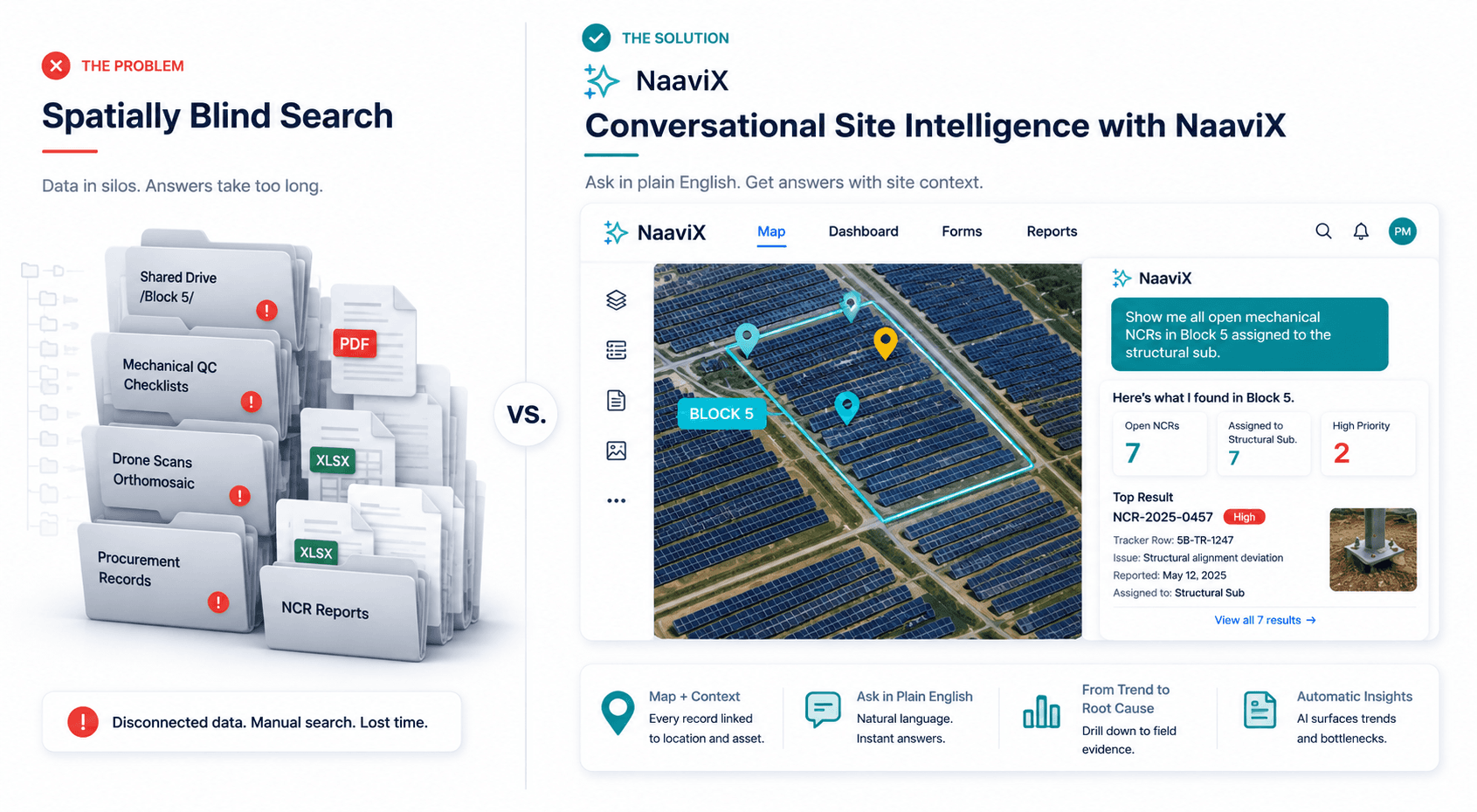
Imagine this scenario. You are sitting in the site office trailer on a Tuesday morning. The Superintendent calls you from out in Block 5, standing in front of a newly mounted tracker row. They’ve spotted a serious structural alignment defect and need a quick answer: Who signed off on this mechanical QC checklist, when was it done, and what did last week's drone scan show?
The clock starts ticking.
You open your document management system and start digging through nested folders. Then you open your spreadsheet app to look for the tracker row’s installation history. Next, you open a separate shared drive to find the drone orthomosaic. Ten minutes pass. Your eyes cross as you bounce between three different screens. Meanwhile, out in the dirt, an expensive field crew sits on their hands, waiting for a game plan.
We call this the "Data Foraging Tax." We collect megabytes of field information every single day. But if your engineers have to act like data archaeologists just to find a single inspection record, that data isn't an asset—it’s a bottleneck.
The Core Problem: Spatially Blind Search
Most construction tracking systems are just digitized filing cabinets. They store your information in alphabetical rows or arbitrary folders, completely isolated from physical reality .
When you ask a traditional system a question, it forces you to use exact keywords or complex filters. It doesn't understand that a mechanical checklist, a drone photo, and a procurement record are all connected to the exact same physical pile or inverter on your site.
If a human with an engineering degree has to spend twenty minutes playing digital detective to piece a timeline together, your software is failing you.
The Solution: Conversational Site Intelligence with NaaviX
You shouldn't need a degree in database querying to find a quality record on a 1,000-acre site. That’s exactly why we built NaaviX AI natively into the TaskMapper platform.
Instead of forcing you to hunt through folders, NaaviX acts as an active, conversational copilot that queries your form records, analyzes project data, and instantly connects the dots across your entire Digital Twin.
Here is what it looks like when your data actually has a map and a voice:
Ask in Plain English: You don't need to build a complex filter. You simply type or speak your question directly to the agent: "Show me all open mechanical NCRs in Block 5 assigned to the structural sub."
Context-Aware Intelligence: NaaviX doesn't just scan for text keywords. Because TaskMapper links every activity to the physical site map and the underlying mechanical hierarchy, the AI automatically understands the relationship between the asset, the location, and the workflow history .
From High-Level Trend to Root Cause in Three Clicks: If NaaviX flags a sudden spike in quality issues, you don't just see a chart. You can instantly drill straight down to view the affected equipment, read the user stamps, check the timestamps, and view the raw, geotagged photos from the field .
Automatic Bottleneck Reporting: Instead of spending your Friday night acting as a "Data Janitor" to build an executive status deck, NaaviX analyzes open form records to automatically compile insightful trends and isolate exactly why a specific zone is lagging.
The Real Win Here: Moving from reactive data-gathering to proactive project control. When your site data is structured and spatially linked, your engineering team stops wasting hours digging through folders and starts focusing on high-value execution.