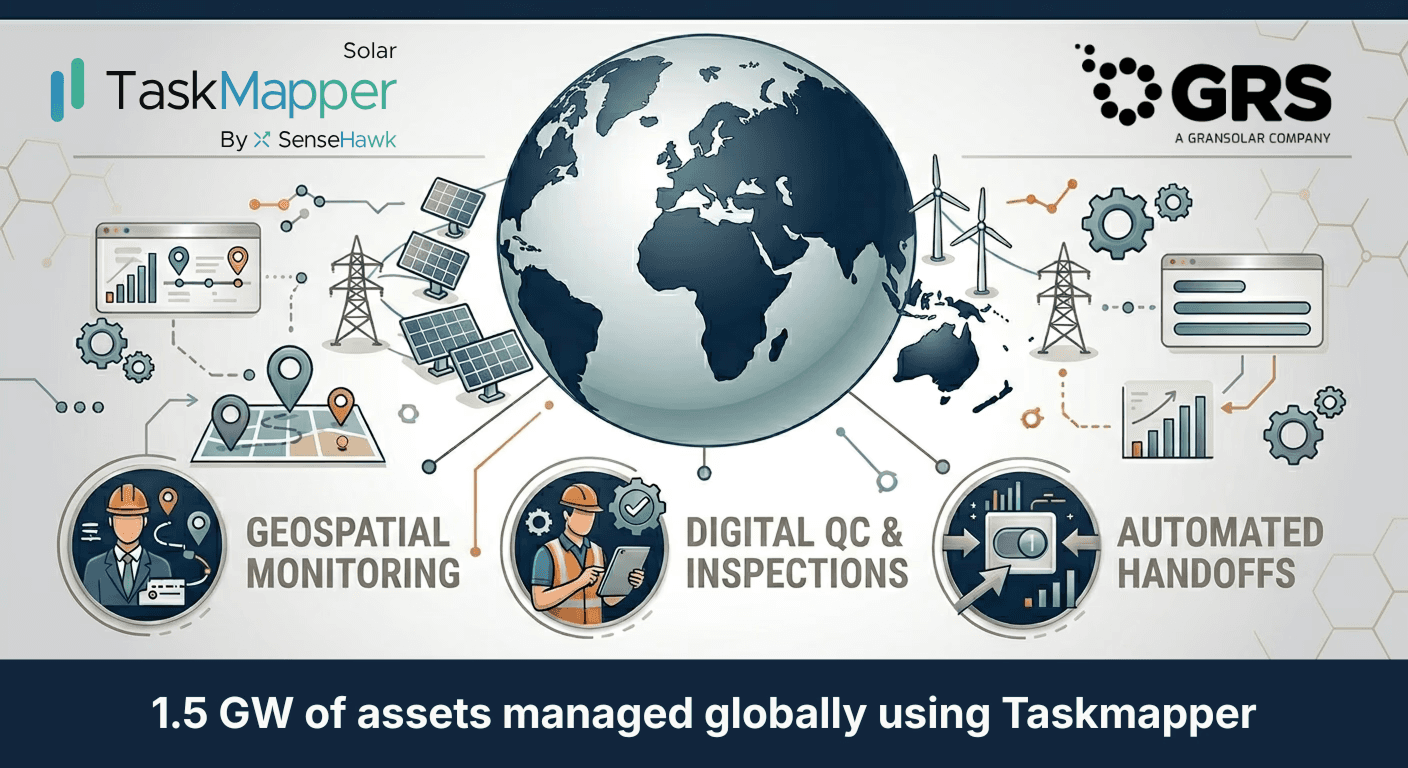
In the world of utility-scale solar, "digital transformation" is often treated as a corporate buzzword. But when an EPC contractor manages projects across five continents, those buzzwords have to translate into a measurable reality.
Recently, we reached a major milestone with our partners at GRS, the solar EPC contractor of Gransolar Group. They haven't just adopted a new software tool; they have standardized their entire global construction operation on the TaskMapper platform.
We aren't looking at a pilot program or a single-site experiment. This is a massive, unified rollout covering a portfolio of over 1.5 GW of capacity across Europe, Africa, and Australia.
The Strategy: Moving from Data Silos to a Global Map
Managing massive, highly complex projects across multiple time zones creates a unique set of challenges. Traditionally, "oversight" meant reconciling fragmented reports from different teams, deciphering site photos without coordinates, and dealing with a constant lag between the field and the home office.
To maintain their track record of on-time, high-quality delivery, GRS recognized the need for a common, map-based operational model. They needed a way to digitize their most critical on-site workflows to gain real-time visibility into global project health.
As Andrés Mateos, EPC Quality Responsible at GRS, noted, the integration of TaskMapper was about more than just data—it was about creating an environment where management teams can ensure they build faster and smarter without ever compromising on quality.
Digitizing the Workflow: Three Pillars of Efficiency
By establishing TaskMapper as their unified digital infrastructure, GRS successfully streamlined three traditionally labor-intensive areas:
Geospatial Progress Monitoring: By moving away from static spreadsheets and toward real-time, map-based tracking, GRS ensures that daily site activities stay strictly on schedule. Every pile driven and every module mounted is pinned to its exact location, providing a "single source of truth" for the budget and timeline.
Mobile-First Quality Control (QC): Quality shouldn't be a post-mortem activity. Field teams now use digital checklists and photo-reports to log issues on the go. This allows GRS to catch, document, and resolve defects instantly, significantly elevating site quality before the project moves to the next phase.
Seamless Commissioning: The transition from construction to grid connection is often where documentation gets lost. GRS now utilizes digital handoffs and automated punch-list management to ensure a smooth, documented transition, providing a clear audit trail for the entire asset lifecycle.
A New Standard for the Solar Industry
Managing a solar site is a feat of engineering; managing dozens of them globally is a feat of logistics. GRS is proving that when field teams are connected via a unified digital infrastructure, they don't just "digitize"—they accelerate.
By automating reporting and connecting their teams through a digital twin, GRS has created a scalable model for deploying gigawatts of clean energy worldwide. We are proud that TaskMapper is serving as the digital backbone for this global journey toward a sustainable future.
Read the full press release here.