For years, Battery Energy Storage Systems (BESS) were viewed as a niche high-premium addition—promising, yet expensive and complex to manage. Today, the landscape has shifted. With plummeting battery costs and the rise of lithium iron phosphate technology, BESS has become a cornerstone of the modern energy mix. In 2025 alone, 58 GWh of new BESS was installed—a 30% YoY growth—with projections reaching 110 GWh by 2030.
However, for solar asset owners, this growth introduces a critical "data gap." While BESS is often co-located with solar, the O&M protocols for these two assets are vastly different. Relying on standard solar O&M teams to manage specialized battery infrastructure without the right visibility is a risk decision that is becoming increasingly difficult to defend.
At SenseHawk, we believe that managing BESS shouldn't be about reacting to incidents, but about building a proactive, digital-first operating standard.
The Visibility Gap: Why Traditional Inspections Fall Short
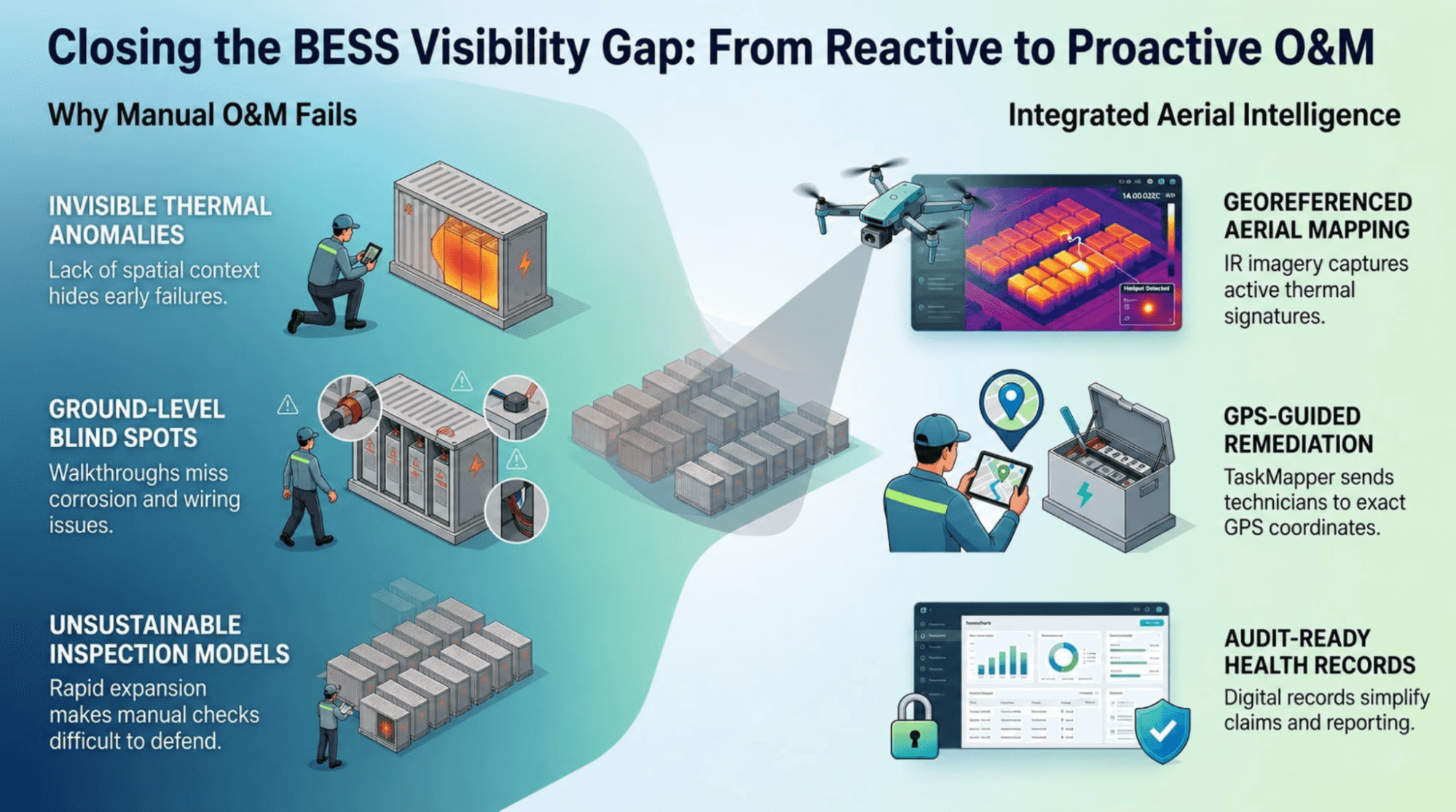
BESS defects are often "invisible" until they reach a point of failure. Ground-level preventative maintenance (PM) walkthroughs are essential but fundamentally limited in scope and speed. Here are the critical risks that often go undetected:
Thermal Anomalies & Load Imbalances: Battery cells generate heat during active cycles. While sensors can flag a temperature spike, they rarely provide the spatial context needed to pinpoint where the failure is starting.
Cable Tray & Wiring Integrity: Compromised conduits and unsecured runs are leading indicators of electrical arcing. Without a bird’s-eye view of the entire yard, these small defects can escalate into catastrophic fire events.
Enclosure & Seal Failures: Corrosion on cabinet surfaces or bolts is the first sign of a failed seal. Once moisture enters a high-voltage enclosure, the risk profile of the entire asset shifts materially.
Civil & Environmental Degradation: Erosion, vegetation intrusion, and oil leaks from transformer fins often accumulate at the edges of large pads—areas frequently missed during manual inspections.
The SenseHawk Solution: Integrated BESS Aerial Intelligence
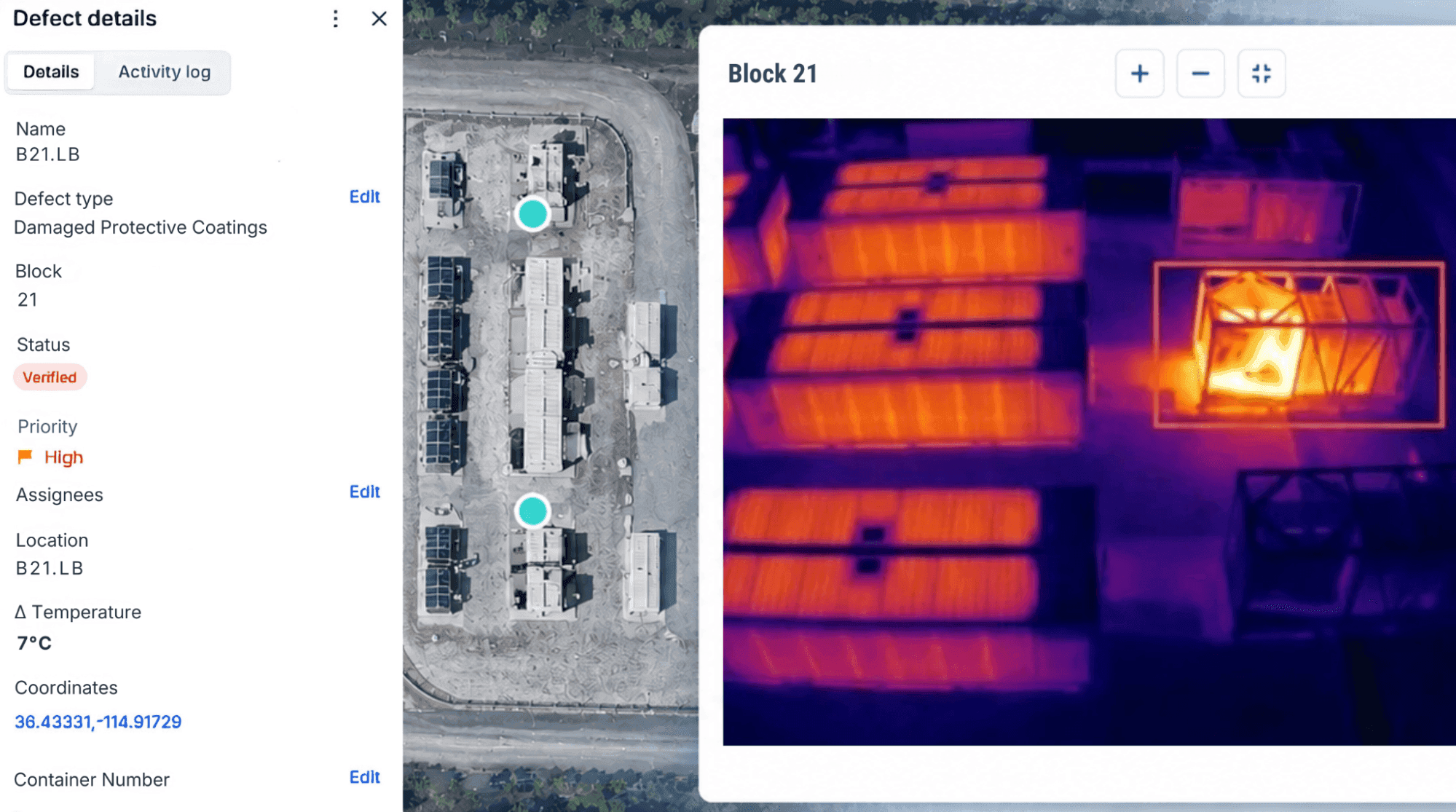
SenseHawk’s approach to BESS yard inspection transforms raw aerial data into a living Digital Twin. By utilizing high-resolution RGB and thermal (IR) imagery captured during active charge or discharge windows, we provide the precise visibility required to catch budding risks.
1. Georeferenced Defect Mapping
Every thermal signature and physical defect we identify is georeferenced and tagged within the SenseHawk platform. Instead of a static PDF report, you get a digital map where every anomaly is a data point linked to its exact coordinate on-site.
2. Seamless Remediation via TaskMapper
Visibility is only half the battle. SenseHawk bridges the gap between the "office" and the "field." Detected BESS defects are automatically converted into actionable tasks within TaskMapper. Field technicians can navigate directly to the geolocated defect using our mobile app, access OEM warranty data, and document the fix in real-time.
3. Audit-Ready Health Records
For asset owners, this creates a structured, auditable record of BESS health. Whether you are reporting to lenders, negotiating insurance premiums, or managing warranty claims with OEMs, having a time-series digital record of your BESS yard is the new gold standard for asset management.
Moving the Needle on Asset Performance
The "cost of doing it over" is the most expensive line item in solar and storage. Our data shows that the assets pulling away from the industry average are those with the most visibility into their own health.
By integrating BESS inspections into the SenseHawk ecosystem, you aren't just checking a box for safety; you are optimizing for uptime. Autonomous drone-based programs allow for high-frequency, high-resolution monitoring that removes the constraints of manual mobilization and pilot availability.
Scaling Storage without Scaling Risk
The economics of solar and storage have changed, and your operating model must change with them. As BESS becomes standard infrastructure, treating its inspection as a "premium add-on" is no longer viable.
With SenseHawk, you can transition from reactive reporting to a proactive, AI-driven program that identifies, classifies, and remediates BESS risks before they become loss events.