It’s 6:00 PM on a Friday evening, and the trailer lights are blazing. Your Project Manager is hunched over two monitors, a cold slice of pizza sitting on the desk. They are brilliant engineers hired to solve complex infrastructure challenges, but right now, they are manually copy-pasting data across three different Excel sheets just to build a progress report for Monday morning.
The problem? Your corporate office just rolled out a standard construction management platform. On paper, it tracks "tasks." In reality, it is completely blind to solar architecture.
When a quality inspector logs a structural defect on a tracker torque tube, the generic software asks for a "Room Number" or an arbitrary "Floor Level." It has no idea where that component sits across three square miles of desert, which tracker row it belongs to, or how it connects to the broader electrical block.
To fix a single asset issue, your field lead has to text coordinates to a supervisor, your planner has to manually open Primavera P6 to see if the delay threatens a milestone, and your logistics team has to open a separate corporate ERP to check spare inventory.
We call this the "Coordination Tax." You don’t have a lack of data; you have data trapped in four distinct, soundproof walls.
The Core Problem: Shoving Horizontal Assets Into Vertical Databases
Most commercial construction software was built for predictable, vertical environments—like a ten-story corporate office or a neat residential layout. They organize data in flat lists and static folders.
Utility-scale solar is a different animal. It is a dense, horizontal network of hundreds of thousands of interconnected components (piles, trackers, modules, combiner boxes, and inverters) spread across vast expanses of land.
When you try to manage a dynamic, multi-disciplinary solar site using a static list tool, you lose all physical context. You get a high-level digital scorecard on Monday, but by the time leadership reads it, the data is already four days old—making it a historical archive rather than a real-time game plan.
The Solution: Orchestrating the Solar Stack with TaskMapper
You shouldn't have to replace your existing software investments to get a connected project. That is exactly why TaskMapper wasn't engineered to be another isolated database—it was designed to be the central geospatial integration engine that connects your entire project lifecycle.
By mapping your existing engineering, schedule, procurement, and field data directly onto a live, interactive Digital Twin, TaskMapper aligns your corporate systems with the physical reality of the dirt.
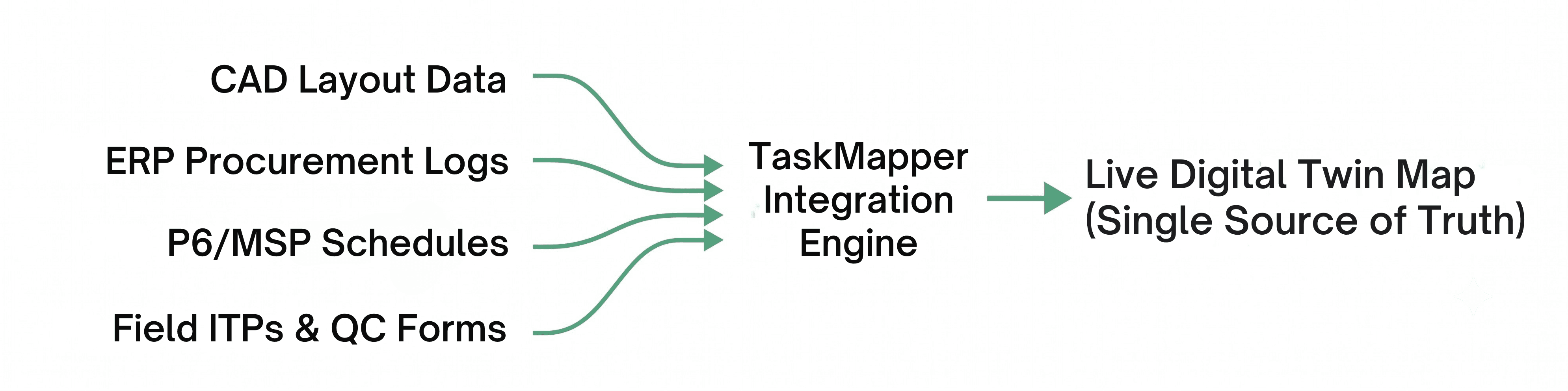
Here is how connecting your existing data silos into a single visual environment changes the game:
Schedules Tied straight to the Map: Your Primavera P6 or MS Project timelines don't live in a vacuum. Schedule milestones are tied straight to absolute geospatial points on the site map. As crews complete ITPs in the field app, your master schedule updates transparently without manual data entry.
Procurement Aligned with the Critical Path: TaskMapper links your ERP material deliveries directly to your active installation sequence. You don't just see a shipping log; the engine flags that a delayed container in the laydown yard is explicitly bottlenecking the critical path in a specific block.
Drill-Down Root Cause Analysis: If your executive dashboard shows a sudden spike in mechanical or electrical NCRs, you don't wait for a weekly slide deck. You click the chart, instantly view the affected piles, identify the subcontractor responsible, and look at the raw photos from the field app in three clicks.
The End of "Version Control" Hell: Because the BI layer is built on top of live field progress and integrated data sources, everyone—from the site supervisor to the VP of Construction—is looking at the exact same reality in real-time.
The True Bottom Line: You cannot steer a hundred-million-dollar energy asset by looking through a rearview mirror. If your project software lacks spatial context, your highly-paid engineering talent will continue wasting hours acting as data janitors instead of driving project delivery.